(C) · AI GOVERNANCE

RAVENTRYX LLC

ISO 42001 implementation that runs after certification.

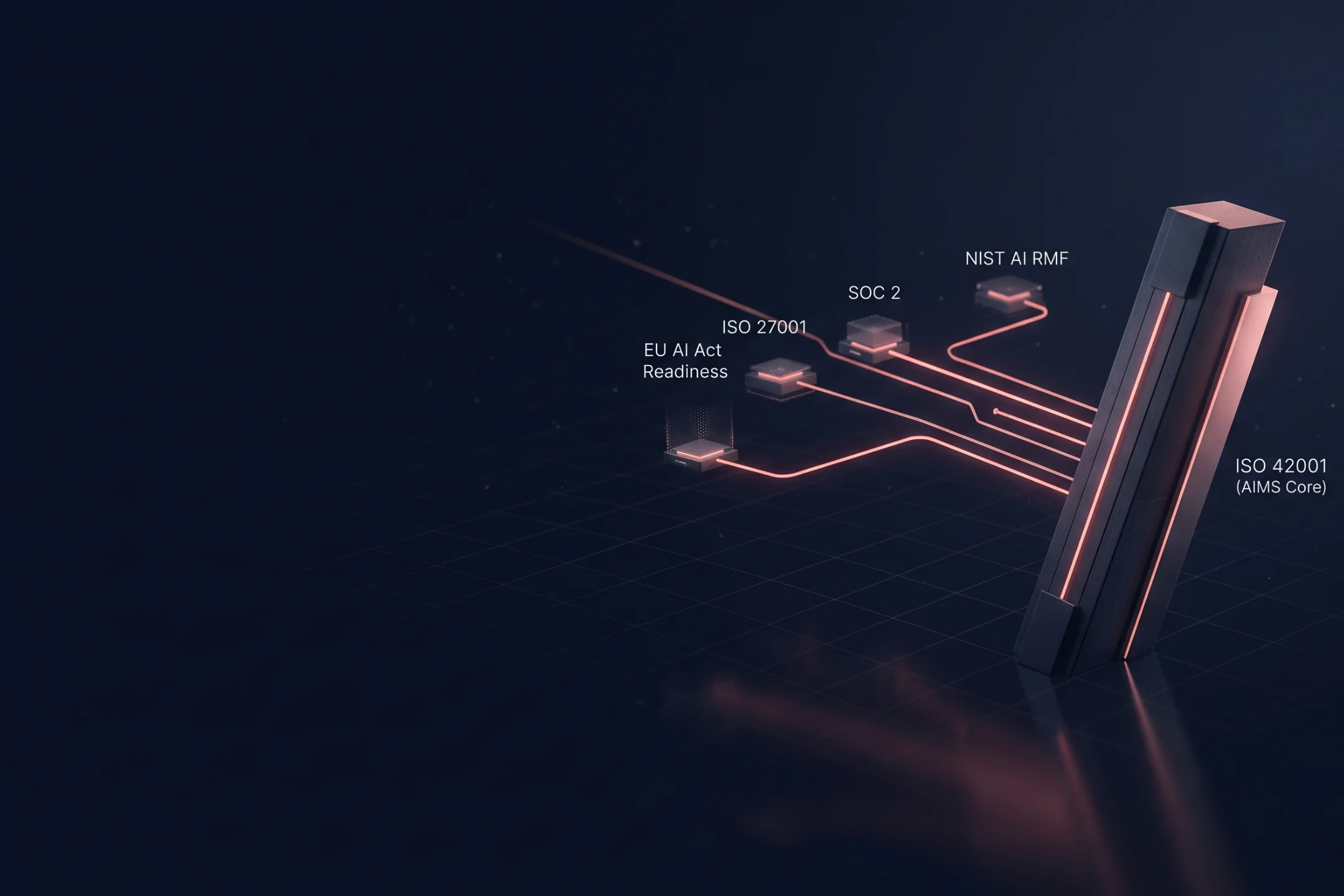
An ISO 42001 certificate is worth little if the management system behind it goes stale the week after the auditor leaves. We build the AIMS into how your team already works, run the internal audit, close the findings, and stay through certification. We design a coordinated control architecture that reduces unnecessary duplication across the EU AI Act, ISO/IEC 42001, ISO/IEC 27001, SOC 2, and the NIST AI RMF. Where requirements differ, framework-specific obligations remain separately identified and managed.


When you need this

An enterprise buyer, an auditor, or your own board is asking for a managed AI governance posture, and a slide deck will not pass. You need an AI management system to the ISO/IEC 42001 standard (the policies, the owners, the controls, the risk process) built to certify and to survive the first audit in practice. AI governance is one of five capabilities at RAVENTRYX; ISO 42001 implementation is the operating system underneath it.

We build the AIMS into how your team already ships, run the internal audit, close the findings, and stay through certification.

How we work it

How this actually goes.

  1. 01

    Scope the management system

    We define the AIMS scope against ISO/IEC 42001: which systems, which processes, which decisions it governs. The scope is set to what you actually run, not to a template, so the controls land where the risk is and the certification covers what an auditor will look for.

  2. 02

    Stand up policies, owners, and controls

    We install the policies, the named owners, and the day-to-day controls the standard requires (the AI impact assessment process, the risk treatment, the operational controls) built into how your team already ships rather than bolted alongside it. The system is designed to support an independent certification process and to keep working without a dedicated minder.

  3. 03

    Run it through the first audit

    A management system that only exists on paper fails its first real test. We run the internal audit, close the findings, and stay through the certification audit so the AIMS holds in practice. Article 9-style continuous obligations and post-market monitoring are embedded, not one-time, so the system stays current after we hand it back.

What's included

The capability, in full.

Sized to what you run

A management system scoped to your actual AI footprint.

We define the AIMS scope against ISO/IEC 42001 (which systems, processes, and decisions it governs) based on what you actually run, not a template pulled from a standard. The scope covers where the risk is and what a certification auditor will look at first. Controls land where they matter; the documentation covers what the assessment will demand.

Start a conversation

What you get

An AI management system aligned with relevant ISO/IEC 42001 requirements and structured to support independent certification if the organization chooses to pursue it, and built to keep working quietly in how your team already ships.

01

A governance system that runs itself.

The AIMS is built into the rhythm of how your team already ships: policies, owners, and controls that keep working quietly in the background rather than a binder that goes stale the week after certification.

Operating, not archival

02

Certification that survives the first real audit.

We run the internal audit, close the findings, and stay through certification, so the management system holds in practice, not just on paper. The auditor gets what they expect to read, the same day they ask for it.

Audited in practice

03

A coordinated control architecture across the framework cluster.

ISO 42001 stands up alongside your EU AI Act readiness, ISO 27001, SOC 2, and NIST AI RMF so the AIMS is the operating layer for the governance posture, with overlapping requirements mapped once and framework-specific obligations held separately.

Mapped once

ISO 42001 as the operating system under your governance posture

ISO 42001 is not a badge for the website and it is not a compliance program you run alongside your AI work: it is the management system that governs how your organization uses AI, from the policies and owners it installs to the risk process it runs between audits. At RAVENTRYX, AI governance is one of five capabilities (the depth behind it lives at /services/ai-governance) and ISO 42001 implementation is the operating system underneath that posture. The standard provides the structured management layer that turns a governance position from a set of good intentions into a system with owners, evidence, and a cadence.

The EU AI Act and ISO 42001 share a control architecture when the implementation is done deliberately. EU AI Act Readiness (the sibling engagement at /services/ai-governance) builds the inventory, classifies the Annex III footprint, and maps the Article 26 deployer obligations. The AIMS is the operational layer that keeps those obligations live between reviews: the Article 9 risk process, post-market monitoring embedded in how your team ships, and the record-keeping that means the next questionnaire is answered from work already on the shelf. Where requirements overlap, controls and evidence can be mapped and reused. Where requirements differ, framework-specific obligations remain separately identified and managed.

Frequently asked questions

What is an AIMS and what does ISO 42001 actually certify?

ISO/IEC 42001 certifies an AI management system, a documented set of policies, owners, controls, and processes that govern how your organization develops, deploys, and monitors AI. The certificate attests that the management system exists, is operated, and meets the standard's requirements, not that any individual AI system is safe. The AIMS is what you are building and certifying.

Do we need ISO 42001 and the EU AI Act, or does one substitute for the other?

They complement each other without duplicating work. The EU AI Act imposes legal obligations (classification, documentation, oversight) that attach at deployment regardless of whether you are certified. ISO 42001 is a voluntary management system standard that, when built on one shared control architecture, provides the operational evidence the AI Act's continuous obligations require. Where requirements differ, framework-specific obligations remain separately identified and managed.

How long does ISO 42001 certification take, and do you stay through the audit?

For most organizations, the implementation and internal audit run three to six months; the certification audit follows. We scope, build, and stay through both, not just the implementation. The management system has to hold in practice on the day the auditor arrives, not just in documentation drafted the week before. We are present through certification and hand back a system that keeps running after we leave.

Regulatory information only. The frameworks, timelines, and standards referenced here reflect our reading of the EU AI Act (Regulation 2024/1689) and related instruments (including GPAI / Article 53 and the Digital Omnibus deferral) as of the review date below. Regulatory guidance and implementation timelines continue to evolve and may change. Nothing here is legal advice, and reading it does not create an advisory relationship. For guidance specific to your organization, consult qualified legal or compliance counsel. Last reviewed: July 28, 2026.

Engage

Starting is the easy part.

How starting works

  1. 01

    Book it

    Pick the assessment, or start with a short call if you want to pressure-test the fit first. No long intake form, no gatekeeping.

  2. 02

    We assess

    An honest read on exactly where you stand, fast. You get a written diagnostic and a prioritized plan, not a sales deck.

  3. 03

    You decide

    Keep going with us, or take the plan and run it yourself. Either way you leave with something you can act on Monday.

What’s in the room with you

  • A senior operator who owns your engagement end to end: no junior hand-off, no rotating cast.

  • A written diagnostic you can circulate internally and defend in front of a board.

  • A prioritized plan with the trade-offs made explicit, costed, and ready to execute.

No retainer to start. No automated drip sequence. A real person, not a bot, replies within one business day. And if we’re not the right fit, we’ll tell you who is.

Proof

We came to them with a slide deck and a checkbox approach that would not have passed a real audit. We left with a management system that runs in how we ship and a certificate the auditor signed off on without a single major finding.

Head of AI Governance · Enterprise Financial Services Platform

Anonymized. Representative engagement archetypes drawn from real mandates; client identities withheld.

Where to start.

  • AI Readiness Assessment$950one-time
Secure Stripe checkout
  • Typical timeline: 2–3 weeks
  • You leave with a written report + plan
  • A person replies within one business day

An AI management system aligned with relevant ISO/IEC 42001 requirements and structured to support independent certification if the organization chooses to pursue it, and built to keep working quietly in how your team already ships.